
- Yang family Tai Chi.
- Tai Chi Steps, Tai Chi Posture Guidelines.
- Online tutorials covering one of the most popular sets of Tai Chi techniques.
- All little details covered. Beginners and advanced readers will find it equally useful.
Yang family Tai Chi: Introduction
The Tai Chi 40 Form set of techniques was created from the "traditional" Tai Chi 108 Form, by removing repetitions and some minor adjustments of the technique. The idea was to create a straightforward form, that is shorter, but still includes all the essential movements.
Therefore, we now have 3 "major" forms (there are many other forms, and they are important, too. The fact that I do not call them "major" should not misgiude you). The first is Tai Chi 24 Form, that by all means should be learned first. It is easier to learn, and some skills that are assumed present in 40 or 108 forms students, are emphasized in 24 forms.
The second one is Tai Chi 40 Form. It is a "fully functional" one, and people that prefer to skip it and jump right to Tai Chi 108 Form, probably make a mistake.
The Tai Chi 108 Form is the third, the longest one. If you are already familiar with the Tai Chi 40 Form, learning Tai Chi 108 Form is just the matter of remembering the order of already familiar techniques.
In this tutorial, we will focus on the Tai Chi 40 Form of Yang family Tai Chi, called after the master Yang Lu Chan.
Tai Chi (Tai Tzi) means "the great limit". Tsuan means "fist". The fist of the great limit. The "limit" is a metaphor here, as many other things in Chinese philosophy, there is no limit, but only our quest for it.
Learning Tai Chi Meditation
One disadvantage the book has, when you compare it to the live class is the fact, that in the class the teacher can repeat the "rules" many times. Like "keep your back straight". In the book I can only do it here and there, otherwise the book will be too long. Nevertheless, there is a reason teachers repeat these rules, and the reason is - the students, especially the beginners, break these rules EVERY time they can. This was your fair warning. Learn the "rules", or find some other name for what you are doing, as it is not going to be "Tai Chi".
Chinese Pressure Points
In the text, I am referring to some points located on the energy meridians. The list of Chinese Pressure Points can be found at this web site.
Tai Chi 40 Form: Sample
0. Initial form.
Tsi Shi
North.
Initial position: heels together, toes together, knees straight, but not locked (just slightly bent). Palms are turned towards the body, touching the sides of the thighs.
In this position, enter the "Qigong state", also called "U-dzi" ("U" as in "book"), the state of a complete mental relaxation, with no thoughts.
Feel your body growing, and dissolving. Of course, at the beginning you will just pretend to be relaxed, later this state will become natural for you.
Concentrate on the bai huei point (top of the head), then move your attention to the lower dan tjan.
"Pull" your body together again, moving your attention and your weight to your right side, starting from the right foot; at the end, 100 percent of your weight should be on your right foot.
As your left foot becomes "empty", step to the left with your left foot, keep your weight on the right foot. It should be as it your left foot stepped to the left by itself. As your right knee remains (almost) straight, the only way to do this step is by putting the left foot on its toes. First, the thumb of the left foot touches the ground, then the second toe ("pointing finger"), the third, and so on. In the same time, begin shifting your weight to the left.
After all toes are on the ground, keep moving your weight to the left, so that the outer edge of the left foot gets in touch with the ground, first its front part, then the middle, then the outer side of the heel.
At the end, your weight should be distributed equally between left and right feet.

By moving your weight from the thumb, by the circle to the heel, you are creating the initial "spin", as all tai chi movements are based in the never-ending circles. This same circular motion creates the initial spin in your lower dan tjan (feel it, or at least keep your attention there).
Also notice, that the point in the middle of your foot (jyn tsuan, see the list of points at the web site) should not be pressed against the ground, it is very close, but if you take a strip of paper, you should be able to push it under your foot, from the side of the thumb. That means, that the weight is more on the outer edge of the foot, then on the inner side. However, in the same time, the thumb must touch the floor.
After the weight is on both feet, we need to turn our palms so that they face backwards. To do it, first, lift your baby finger from the surface of your thigh, as if it "knows" where the palm will be, and is going there. Then lift the ring finger, and so on, every time turning the palm a little, too. The last, thumb is turning. Keep your attention at the finger that currently moves. Also, make sure your dzjan dzi points (shoulders, see the list of points at the web site) are relaxed.
Note, that all that was said at the web site about the way your palms should be in Qigong, applies to Tai Chi as well. The fingers should be straight, forming a line (not an arch) with the palm. There should be an arch between the thumb and the pointing finger (not a sharp angle), and there should be an arch between the thumb and a baby finger (which means the thumb should not be in the same plane where the palm is).

The "meaning" of our stepping to the side with focus on the circles was "waking up" the circles in the lower dan tjan and in our body in general. The "meaning" of the next form is to "awaken" our palms.
Imagine that there are two spheres, size of a footbal ball, right at the level of your palms. You need to allow your palms to move around them, brushing their surface. In the same time, as your attention goes to your palms, the palms should become warmer. When you practice Qigong long enough, you will be able to turn your palms red just by focusing on them.
This little sub-form takes about 5 seconds to complete (you can do it slower if you choose to). As your palms move, they may turn a little, to point at 45 degrees to the sides.
After your palms moved all the way back, move them forward at the same trajectories, to end up in the position where you have started (fingers pointing down, palms turned back).
Note that we only move (bend and turn) palms, elbows and shoulders are not supposed to move during this exercise.

Imagine, that your hands are very (infinitely) long, that they go down in the ground. Keep your attention at the points dzjan dzi at your shoulders, making sure the shoulders are relaxed and down. Hands should NOT be tense.
Bring your hands up-forward to the shoulder level, keeping the feeling that they are very long. The coccyx should be turned forward, or (the same thing) you should push your min men point back, keeping your back flat, with no curve forward in the waist. If you do it correct, you will be able to raise your hands without using physical strength, even if someone staying in front of you is holding your wrists. You will push him forward, while the force he applies to you will go down, through the middle of your feet, into the ground. Note, that if your back is not flat, this same force will break your balance and you will fall back.
Then (do not think of long hands anymore) bend your hands slightly, and allow your hands to go down, until the angle between them and your body is about 30 degrees. All this time your palms should be parallel to the ground.
While bringing hands down, bend your knees, so that your body moves down to the "working" depth (Chi Shi). The way it is shown at the picture is fine for an average Tai Chi student.
The most important thing to keep im mind when choosing the "working debth", as well as when doing ANYTHING in Tai Chi, is NOT to break rules. Let's say you are going down by bending your knees. Then at some point you will reach a limit. To sit lower, you will either have to bend forward (against the rules: you must keep your back straight), or to move your coccyx back (against the rules: it will bend your lower back forward. The lower back must be straight, you should always push the "min men" point back a little bit). Or you will have to move your weight to your toes, which is wrong, too. Therefore, you should not go down below that limit. Note, that recognizing your limits (and fixing problems as they appear) and opponent's limits (and forcing him to break them, and therefore to loose the balance) is an important part of Tai Chi martial techniques.

1. Ward-Off Left
North
Unlike in Tai Chi 24 Form, in Tai Chi 40 Form we may turn on the "loaded" foot. To comply with the tai chi rules, we need to make this foot empty WITHOUT physically moving our body towards the other foot. It may seem impossible, but is, as the matter of fact, simple.
As your weight is on your "loaded" foot, move your attention up, from the foot to the lower dan tjan (it may look as a little move back and then forward again). As the result, for a moment, your foot will become "empty", while still carrying your body weight.
At the following picture, we move the attention ("chi", actually) up, making the foot empty, and then turn the front foot. Note, that the "coordination" rule still applies, we can only turn the foot together with hips.

Move your weight to the right foot and turn 45 degrees right (North-East, NE). In the same time, "take the ball", left hand at the bottom of an imaginary sphere, right hand at top.
We need to step North from the position described above. First, bring your empty (no weight on it) left foot towards the right foot (din bu position, facing NE).
Then turn left (N), and do an empty step North with your left foot. Note that (you should always keep in mind things like that as doing Form 40 assumes that you are an "advanced" student) we plan to end up in goon boo position at the end of the form. It means that you should not put your left foot to the line that goes North from your right foot. If you do it, then your feet will be too narrow and you will not be able to do a proper goon boo position. Instead, you need to step NW (still facing North), it will guarantee, that in the final goon boo position your feet will be shoulderwidth apart. Note also, that the left foot still points North (as your hips are turned North).

In the same time with the empty step, move your left hand up, fingers point to the right, wrist (where you would usually wear watches) pointing outside. Move the right hand down, palm down, fingers pointing forward. Half-way, when your hands meet, the fingers of your right hand should touch the inner side of the left wrist (the pulse). We do not exaggerate it in this form, but this is a (reduced) push, as if you are making your personal space larger by pushing with your right hand onto your left hand and with your left hand onto your opponent. Once again, in this form it is just something to keep in mind, not the actual push. In the same time (when hands touch each other) your left heel should touch the floor.
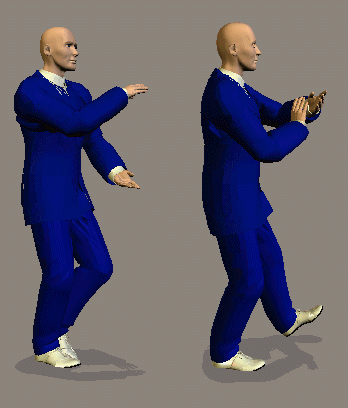
Move 70% of your weight to your left foot to end up in the left goon boo facing North. As you are moving your weight, move your left hand forward at the level of your middle dan tjan (the heart), as if you are pushing against something. Your right hand goes down and to the side. It ends up at the level of your hip, 30 degrees forward from the plane where your body is (see "rules" listed at the web site).

Turn right (East) on your loaded left foot, the final position is right din bu, hands holding a ball.

2. Grasp the sparrow's tail
Lan Tsuevei
East
Initial position: left din bu, hands in the "holding a ball" position, facing East.
This form is one of the most important in Tai Chi Meditation, as it includes most of its basic principles.
Phen (pheng)
Block the attack at the face level with your right hand. The palm goes up approximately to the eye level, at the beginning its thumb is up (he gu point up), at the end it should be baby finger up.
The hand is lifted only by the shoulder joint, while the elbow does not bend. Keep in mind that, as always, the shoulder should remain relaxed, and DOWN, do not lift the shoulder (by "shoulder" here we mean the shoulder joint, as the hand goes up, the shoulder joint should go down).
In the same time, bring your left hand towards the solar plexis, by the small curve, blocking it, palm forward, fingers up.
In the same time do an empty step forward at 45 degrees, heel touches the floor first.
Move your weight forward, to end up in the right goon boo, facing East.

Lui
"Give the hands away", entering a fully relaxed state. Every move in Tai Chi begins and ends in a fully relaxed (not weak, but mentally relaxed) state called "u dzi" ("u" as in "book"). The relaxation is an inner thing, some kind of readiness to move in any direction without resistance or delay. Also, keep in mind, that "relaxed" hands have nothing to do with high amplitude waving hands, the "lui" is a compact and fully controlled technique. As soon as you enter an empty state, the next movement will appear by itself, from this emptiness.
Turn both hands. If the palm was up, it will be down, if it was down, it will face up. In our case, turn the right hand palm down, and left hand palm up. Keep your palms parallel to the ground and at the same level. It is necessary to lock your opponent's elbow properly (as one of the possible interpretations). Keep your fingers straight - even if you work with the real partner, this is a push with palms, not a grasp.

The idea of lui (there are many variations of this technique) is to guide opponent's power, so that you are unaffected, while he loses balance.
Turn the back (left) foot a little bit outside, move your weight on it, and pull opponent's hand in front of your center (lower dan tjan), parallel to the ground.
Note, that the term "pull" above is not quite correct. You are not pulling, but rather pushing down with your hands and moving your opponent around by turning your hips.
As you turn your hips, the foot of the front (right) leg should turn, too, pointing in the same direction with hips.
Also note, that we are NOT moving hands sideways on this technique. They are in front of our body all the time. By turning our hips, we may create an illusion of hands moving to the side, but it is just an illusion. This is a very important detail, used in many martial arts, from Tai Chi, to Aikido: when you pull with your hands, you can only produce a fraction of the power that you can create by turning hips instead. This is a simple mechanics: your hips are stronger than your hands.
Also, if you pull by moving your hands to the side, your right armpit will eventually close, which is against the principles. Your opponent can use it by pushing on your elbow, if the armpit is closed, you will have no power to push back.

Dzi
Move your front (right) hand by the circle down, then up in front of your solar plexis. The final position should be the following: the hand (from the wrist to the elbow) parallel to the ground and to the chest, the distance between the hand and the chest is about two widths of a palm. The left hand touches the right wrist (a baby finger is at the pulse), fingers of the left hand pointing up. If you stay in front of the mirror, you should be able to see fingers of your left hand, except for the last (closer to wrist) joints.
Move your weight to the front foot (goon boo position), push forward with your right hand (between wrist and shoulder), and push at your right hand with your left palm. However, during the weight transition your right hand should remain at the same distance from your chest. It means, as in the "lui" above, that we are using the power of hips, not the power of hands. Only at the end you may "extend" the circle your hands forming, as if you breath in, increasing your personal space. At that point your hand may move forward a bit, increasing the distance between it and your chest.
Keep your attention at the lao gun point (see list of points, awailable at the web site), and make sure your fingers are straight and stretched out, as opposed to half-bent and weak.

An
Allow your left hand to "crawl" forward around the right wrist (from the thumb / pulse towards the baby-finger), the final position is: hands extended forward at the shoulders level, wrists crossed. Make sure wrists are straight (not bent).
The "an" means "waves".
Move your wrists apart, in the position "hands are forward at the level of shoulders".
Move your weight on the back foot, in the same time hands move a little bit sideways and down. Then push forward, think of pushing opponent's shoulders.
Unlike in Tai Chi 24 Form, in Tai Chi 40 Form we do not lift the foot when moving weight back (in this particular exercise).
Note, that you shouldn't move your hands down too much, or you may end up in a position, from which it is not comfortable to perform a push forward.


Transition to the next form
Turn left on the loaded right foot, 180 degrees. Your body should rotate around a vertical spine, without moving weight to the other foot.
During this spin, your hands should slide along the inner surface of an imaginary sphere (or cylinder), imagine, that you are being pushed back and you need to turn and to direct the pushing force around you. Your body is turning using this imaginary "pushing force, that comes to you through your hands. Do not bend your elbows.
It is important to keep in mind that this turn, as well as all Tai Chi moves, originates in your hips.
Bring the left foot to the right foot, its toes touching the floor (din bu position, facing West). Later in the next form it will do a step West, to end up in a left goon boo position (West).

3. Single whip.
Dan Bjan
West
Initial position: left din bu, facing West. Right hand forms a "claw", at the level of a shoulder, left hand is palm up, its fingers touching the right wrist at the pulse area.
How to form a "claw" (a hook): the four fingers should touch the side of a thumb, imitating the grasp on an imaginaginary opponent's hand. DO NOT bend the wrist.
Do an empty step towards West with the left foot, heel down, at 45 degrees, so that we eventually end up in a proper goon boo.
Move the right hand back a little bit, but make sure it is still 30 degrees forward and NOT in the same plane where the body is. In the "whip", at the very end, we are going to turn the body right a little, and it may create an illusion of the right hand being in the same plane with the back. It is not so, it is still 30 degrees, as stated in the "rules" at the web site.
As you turn your body, the left hand moves too, together with the shoulder and NOT by itself. At the end of a turn, the right hand goes a little (just a little) up, and the left hand goes a little bit down. In the same time, the left wrist bends up, but just slightly, the wrist is still almost straight.
In the final position your shoulders should be turned inside a little bit more than your hips. Your left hand should be at the shoulder level.

Keep in mind, that all moves come from the hips. Particularly, in the "whip", you need to turn first, and only then to do an empty step. It is not allowed to turn and step in the same time.
Unlike in Tai Chi 24 Form, where the opponent's punch is aimed at your face, in the Tai Chi 40 Form it is aimed at your chest. Your blocking (left) hand should move accordingly.
The meaning of this form is: 1) while turning, we have blocked the opponent's punch, and lifted his hand. 2) while doing an empty step, we pushed his hand to the side. 3) while moving forward into a gun bo position, we pushed his hand down with our hand.
Keep in mind, that hands and legs should move in a synchronized way. This is the reason Tai Chi is called a dynamic meditation - by doing complex synchronized forms we achieve the inner emptiness and relaxation. In this particular form we have 3 parts (turn - step - goon boo) and 3 hand techniques, synchronized together.
Also keep in mind (as always) that the center of gravity should not go up and down - it is moving parallel to the ground.
Keep your hands "long", do not bend elbows too much, and do not bring your hands too close to your body. If you do it in a combat situation, the punishment will follow, immediately.
4. Raise hands
Ti Show Hanshi
North
Turn right (North) on your loaded left foot and bring both hands down by circles, half way they move down-outside, the second half down-inside (towards the central line). As your hands go down, the thumbs should point down.
Turn palms fingers up and bring hands up in front of your body.
In the final position, fingers of the left hand should point at the right elbow, and the fingers of the right hand should point up. The right hand (its fingertips) is at the level of your chin.
You are now in the sui bu position, the front foot is touching the floor with its heel. Make sure your armpits are "empty".


Note that it is a "position", not a martial technique. You are supposed to simply raise your hands, not to block or attack someone. We simply did opening and closing and ended up in sui bu facing NE.
By the way, regardless the fact that, unlike in Tai Chi 24 Form, we do not have to move the weight on the back foot in order to turn the front one, nothing prevents you from doing it, especially if you have sore knee, or some problems with the balance.